
But I already breathe, don’t I?
True. You’ve been breathing your whole life, and it works fine without you. Breathwork starts the moment you do show up for it. You breathe consciously and notice what happens in your body.
That’s it. The rest of this piece is about why the breath, of all things.
What we’re missing
What we’re missing isn’t a technique. It’s an insight. A very simple insight.
You are human.
Somewhere along the way we got something extra. Through evolution, through a few magic mushrooms, through God or the universe. Take your pick. We got the ability to think.
That thinking is fantastic. It gave us fire, language, music, houses and apps. Almost everything around you was a thought first.
But it also carries us off. Into the future. Into plans, shopping lists, arranging things. Or into the past. A wrong choice. A memory. We started doing nothing but think. And that’s where we stay. Even when there’s nothing to solve.
Still, that thinking came with something. Something we should probably see as a small consolation prize. We can actually steer something.
Your heart beats by itself. Your blood flows by itself. Your temperature regulates itself. You have no say in any of that. Your breath also goes by itself. But at the same time, you can regulate it yourself. Slower, fuller, still for a moment.
Of everything your body does by itself, the breath is the only thing you can also steer consciously. That makes it unique.
And that breath takes place in your body. Not in your head.
That’s where the two meet. Thinking and breathing. Your head can join in for a moment, your body does the work. And your breath is always here. You can’t breathe in yesterday. Or tomorrow. That’s what brings you back.
It’s that simple. That’s why we start with the breath.
My head
I know how that thinking works. If something runs stiffly or Chris complains about something, my head instantly fills up with solutions. Lovely, until it won’t switch off.
Breathwork was the first thing that got me out of there for a while. Not by explaining something, but by letting me experience something. Now I guide others in it.
There’s nothing wrong with you. You just never stop. You don’t have to believe in anything and you don’t have to improve yourself. You’re already breathing. You’re just going to be there for it.
One word, many kinds
Breathwork is an umbrella term. Basically, there are four forms.
- Calm and slow. Fewer breaths per minute, often with a longer exhale.
- Fast and strong. Breathing a lot and powerfully, sometimes with breath holds.
- Connected. You breathe in and straight back out, without a pause in between.
- Still. You turn your attention to your breath and change nothing about it.
Around these, methods with a name have grown. The Wim Hof Method, Holotropic Breathwork, Transformational Breath. Many people get something out of them, and that’s great. We don’t work from them.
A method with a name brings rules, its own language and its own way of breathing. That gives something to hold on to. But it also creates an inside and an outside, and more head again. If you know the method, you belong. If you don’t, you’re left outside. And often it keeps getting more intense, while that isn’t needed at all. Harder, longer, colder.
Meanwhile the source is left untouched. And it’s simple: you’re already breathing, and you can be there for it.
It resembles what sometimes happens with a religion. The core of the story is simple and for everyone. Around it grow rules, rituals and a building. One day it’s more about the building than the story. And what should connect people ends up shutting them out.
We go back to the core. No name, no membership. You and your breath.
Are you mainly looking for a performance or a big energy boost? Then one of those methods is a better fit for you. That’s fine too.
What we do
We start with conscious, connected breathing. Through the nose, calm and full, in and out, without a pause in between. At a pace and depth that feels good.
Why without a pause? Pay attention to it today. You read a difficult email or hear something that touches you, and your breath catches. That happens all day long without you noticing. Connected breathing lets your breath flow again.
For us, conscious means: you’re actively working with your breath. You keep the rhythm going, but without forcing. You don’t have to keep breathing deeper or harder. It’s about experiencing the connection between the inhale and the exhale. That can get intense, but harder is never the goal.
Are you prone to hyperventilation, or do you want it gentler? Then we work with the still breath. You turn your attention to your breath and otherwise let it go its own way. Many people notice their breath softens by itself. That’s not a light version. It’s the core: being there.
What happens in your body
If you breathe faster or deeper than your body needs, you breathe out more carbon dioxide (CO₂) than your body produces. You may then feel tingling in your hands, feet or face, light-headedness, or cramping of your hands or mouth.
That’s a signal to slow down, not to push on. Once you breathe calmly again, it usually fades.
Is that hyperventilating? With active connected breathing, yes: you consciously breathe more than your body needs. The difference with an attack that happens to you: you build it up, and you can slow down or stop at any moment. With the still breath, you don’t hyperventilate.
And that extra oxygen you often read about? Your blood is already almost full of it. Breathing a lot raises it just a little. But your body gets little out of it. With less carbon dioxide, your blood actually releases oxygen less easily, and the blood vessels in your head briefly narrow. That’s where the light-headedness comes from.
Sometimes emotion comes up. Being moved, sadness, anger, laughter. When you’re less busy thinking, you notice what was already there. You don’t have to do anything with it. It’s allowed to be there.
How a (private) session goes
We start with an intro call. In it, we see whether breathwork suits you and talk about safety.
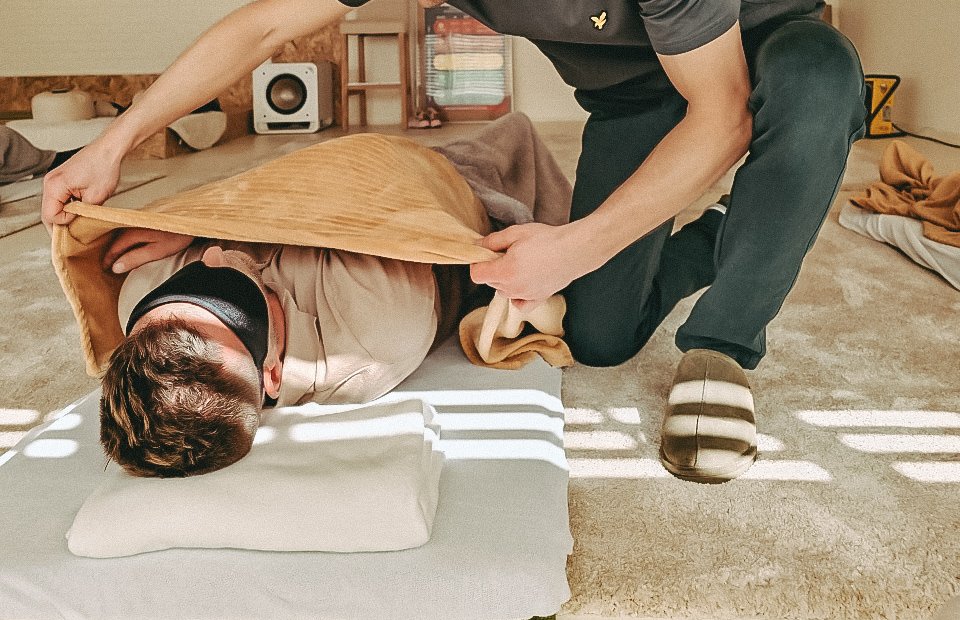
During the session you lie comfortably, eyes closed, with music in the background. I guide you with my voice. Sometimes with bodywork: light touch, always after explaining it and only with your permission. A no is always fine.
You set the pace. Slowing down, pausing and stopping are always allowed.
After the breathing you stay lying down for a while. If you like, we talk afterwards.
A private session takes about three hours, of which we breathe for roughly forty-five minutes to an hour.
You can also do it at home, with Reconnect and soon with InnerSeed Garden, both in Dutch for now. Then you’re your own guide. For me, 10 to 15 minutes is often enough.
What you may notice
No two sessions are the same.
- In your body: tingling, warmth or cold, trembling, feeling heavy or actually light.
- In your feelings: being moved, relief, crying, laughing or anger.
- In your head: a dreamy state, images, memories or insights.
- Little or nothing: also fine. Sometimes you notice it later, in a quiet moment.
Someone wrote after a session that it was “hard to put into words”. True. So this piece is only half the story.
What it isn’t
Breathwork doesn’t cure anything. It isn’t therapy, doesn’t diagnose and doesn’t replace a doctor or psychologist. Therapy often starts with talking and understanding. We start with feeling. The two can exist side by side.
When not to
Breathwork can be physically and emotionally intense. A few fixed rules:
- Never in or near water, not in an ice bath either. After connected breathing, you feel the urge to breathe less quickly. Fainting in the water can be fatal.
- Never in traffic or anywhere fainting is dangerous.
- Stop immediately with chest pain, shortness of breath that doesn’t ease, a severe headache, or if you really don’t feel well. Is it serious? Call 112.
- No active breathing session after alcohol or drugs, with a fever or when you’re acutely ill.
- Are you in a crisis or having thoughts of suicide? Reach out for support: your GP, or 113 Zelfmoordpreventie in the Netherlands (113 or 0800-0113).
With pregnancy, cardiovascular disease, high or low blood pressure, epilepsy, severe asthma, PTSD, a panic disorder, a bipolar disorder or a psychosis, among others: consult your doctor or therapist first and let us know. Then we’ll look together at what fits.
The full list is on our safety page. In doubt? Ask us, before you book.
Try it for a moment
Reading this was thinking again. So, not for a moment now.
On the Dutch version of this page there is a short three-minute session, guided by my voice. An English one will follow. Until then, you don’t need it.
Sit or lie down somewhere you don’t have to pay attention to anything. Not behind the wheel. Set a timer for three minutes and breathe through your nose, calm and full, without a pause between in and out. Or just notice your breath. You don’t have to do anything.
Does your breath soften by itself? Fine. Does nothing happen? Also fine. If it makes you restless, you stop.
Want more? Book an intro call. Or keep breathing at home with InnerSeed Garden, our app. It’s on its way, in Dutch first, and you can already sign up.